Cynical Reason’s Neatest Trick!
Cynical reason, as defined by Slavoj Žižek via Peter Sloterdijk, is as follows:
“Peter Sloterdijk puts forward the thesis that ideology’s dominant mode of functioning is cynical, which renders impossible—or, more precisely, vain—the classic critical-ideological procedure. The cynical subject is quite aware of the distance between the ideological mask and the social reality, but he none the less still insists upon the mask. The formula, as proposed by Sloterdijk, would then be: ‘they know very well what they are doing, but still, they are doing it’. Cynical reason is no longer naïve, but is a paradox of an enlightened false consciousness: one knows the falsehood very well, one is well aware of a particular interest hidden behind an ideological universality, but still one does not renounce it.”
Examples of cynical reason understood as, and I repeat, ‘they know very well what they are doing, but still, they are doing it’ are:
- Stating that ‘paedophile, vampiric elites run the world’, as if knowledge of such an idea is tantamount to being above it.
- Slobbish people watching a TV show about slobs and laughing as if above their situation.
- Working for a company whose values you find hollow, rolling your eyes at the mission statement, joking about it with colleagues afterwards, and yet still showing up on Monday.
- ‘Ironically’ wearing a McDonalds t-shirt. Wherein, the irony lets you participate while pretending to be above it.
- The self-aware advert that states what it is bluntly, as if this somehow assuage it’s complicity in what it explicitly knows is bad.
- The therapised verbalizer! Someone who can articulate their toxic patterns with clinical precision. "I know I self-sabotage, I have an anxious attachment style", therein using that vocabulary to describe rather than change, the knowledge itself becoming a substitute for action.
Let’s take these statements as foundational statements of cynical reason. So, a foundational statement of cynical reason is a statement that is cynical, but that very cynicism allows it to reason its way out of the implicit issue, thus the statement becomes a self-contained projection/defense mechanism allowing someone to believe themselves to be above something because they know about it.
Now, I am about to form a rather strange hierarchy, and these foundational statements sit at the bottom of the pyramid, on level 1, making them CR1 statements.
CR2 statements are, strangely enough (considering they actually sit above CR1), the initial claim/fact that leads to the utilization of CR altogether. CR2 statements might look almost identical to the aforementioned CR1 statements, but stop short of recursion. Wherein a CR1 statement believes that its knowledge is the cynical justification to reason itself out of the conclusions of said knowledge, CR2 statements are matter-of-fact, and either accept the knowledge as-is or seek to change the circumstances they perceive as bad; they emphatically do not believe that said knowledge pardons them from the reality of the knowledge or somehow makes them 'above it all'.
CR3 statements are a bit trickier; in fact, they are cynical reason’s neatest trick! As you should be able to see, CR1 statements, that is, knowing very well what one is doing and still doing it, is justified apathy, smug privilege, and a practical definition of nihilism. What CR3 statements do is utilize the cynicism of CR1 statements to bolster their own wills. A double cynicism or, recursive cynicism, if you will. Where cynicism was once a subversive response to society and/or the prevailing ideology, the cynicism of CR3 statements captures both the affect of cynicism and the apathy of CR1 statements as a means to consolidate their own power. CR3 prevents genuine cynicism by mimicking subversion. The underside of power is made visible, and that very visibility becomes a proof of authenticity.
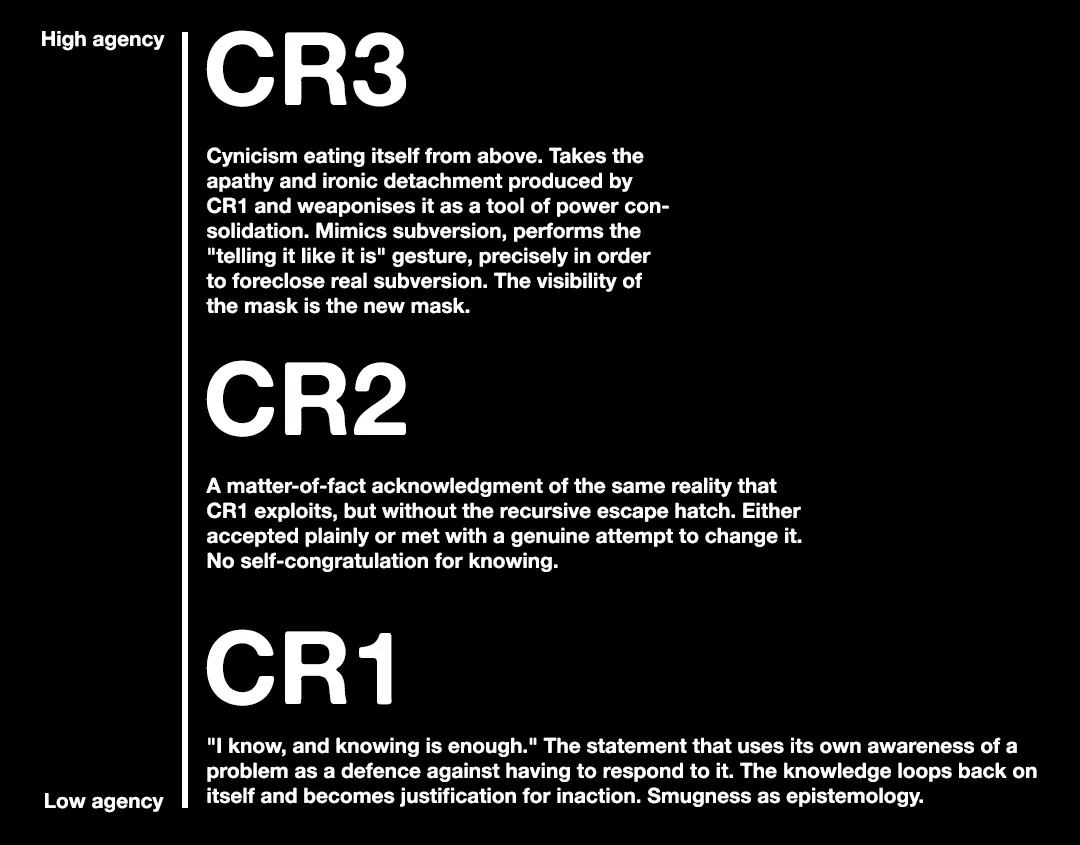
The hierarchy (above), which I plot along a Y-axis relating to agency, is counterintuitive for a few reasons. Firstly, because CR2, the lowest sounding, is actually the most honest, being the baseline perception before cynical reason gets its hands on it. CR1 corrupts it inward, into paralysis. CR3 corrupts it outward, into manipulation. However, this doesn’t mean CR2 has the most agency, because it has to exist in a cynical world. Therefore, it sits in the middle of the hierarchy, with CR3 drawing up the apathy of CR1 to bolster its own ideological position. CR2 sits largely idle, for when it speaks, it is either derided from below, “Yeah, we know!” or from above, “Yeah, we know and that’s why we are the answer!” Reality is ignored in favour of smugness or the double mask.
Politically applied, the CR hierarchy appears as follows:
CR2: These are the legitimate grievances that actually exist and that both movements feed on:
- Political institutions are captured by donor and elite interests
- Deindustrialisation has genuinely destroyed communities
- Cultural institutions often reflect the values of a narrow class
- Immigration does produce real pressures on wages and housing at the lower end
- Mainstream parties have largely stopped representing working-class material interests
CR1: The MAGA voter or Reform voter who says "they're all corrupt, the system is rigged" and then:
- Votes for a billionaire or a commodity trader
- Disengages from local politics entirely
- Treats the whole spectacle as entertainment
The knowing detachment of "I know it's all broken" or "The world's fucked!" becomes the reason not to organise, demand policy, or hold their own representatives accountable. The cynicism is the apathy. Awareness of the system's corruption is converted into a reason to surrender to it under a more exciting banner.
CR3: Trump and Farage are CR3 operators almost perfectly:
- They perform CR2 awareness, "the establishment is corrupt, the media lies, the experts are wrong," etc., often true enough to land
- That performance mimics CR1, the vulgar laugh from below, the speaking of unspeakable truths but it's deployed by people inside or adjacent to the very power structures being named
- The visibility of the corruption becomes a seeming proof of authenticity rather than a call to structurally address it
- And crucially, it captures the CR1 apathy of the base, people who've stopped believing in anything are handed a figure who validates that disbelief and redirects it as energy toward the movement
Genuine CR2 perception is real, CR1 apathy is real, and CR3 harvests both. Farage saying "the political classes are all the same" is simultaneously true as CR2, resonant with CR1 voters, and a CR3 manoeuvre that prevents those voters from noticing that Reform offers no structural challenge to anything, just a change of personnel at the top.
Anyway, just a little grammar to assign to various LARPy bits and pieces you seen on the news going forward. "Hey, that's a CR3 statement!"