Middling Occultism
This is the first in a series of posts entitled Meddling with the Occult, the purpose of which is to tackle the topic of occultism from the perspective of an honest, modern practitioner. Let us start, then, quite aptly, with a definition. They always clear things up, right?
The occult (from the Latin word occultus; lit. 'clandestine', 'hidden', or 'secret') is "knowledge of the hidden". In common usage, occult refers to "knowledge of the paranormal", as opposed to "knowledge of the measurable", which is usually referred to as science. The terms esoteric and arcane can also be used to describe the occult, in addition to their meanings unrelated to the supernatural. The term occult sciences was used in the 16th century to refer to astrology, alchemy, and natural magic. (Wiki)
At first glance, this definition appears helpful, but the more you read and re-read, the further the whole thing falls apart. The reason I start with the definition is that practitioners themselves are quick to reach for it, usually (and quite in keeping with their character) to handwave away social awkwardness. See, ‘occult’ does, technically, mean ‘hidden’, and that’s the quick, social manoeuvre to keep conversations from going awry. Occult simply means hidden! says the pale-skinned man, all clad in black, eyes too intense for a pleasant lunchtime, as he fingers his crystal necklace. Hidden! Sure, that’s exactly what it means…
It just doesn’t mean that, though, does it? Lots of things are hidden that we wouldn’t think of defining as occult, and even those that are—again, technically—occult **we would feel strange if they were openly deemed as such. For instance, technically a doctor might say, We’ve got your stool sample back and found some occult blood. To which you might reply, What the fuck are you on about? Because that’s simply a weird thing to say. The doctor would, in fact, say, We found some blood in your stool. Anyway, blood and excrement aside, the point is that the word occult doesn’t mean hidden. Technically it does, but not really.
Then we have the common usage of the term occult, meaning "knowledge of the paranormal", as opposed to "knowledge of the measurable", which is usually referred to as science. The terms esoteric and arcane can also be used to describe the occult, in addition to their meanings unrelated to the supernatural. See, now here the issue is that as soon as we’ve commonly tried to define the word occult, we’ve become reliant on roughly 5 other terms that need further explanation. Not to say it should be able to stand alone, as Derrida knows no such thing is possible, but I’d like to think we can at least not enter into such a linguistic mess, but then, maybe that will just be the case?
So, to start this whole meddling series off, I want to work toward some sort of definition. Primarily because the term occult is bandied around with a bunch of other terms that are just as difficult to define, such as:
Magic, religion, enlightenment, mysticism, [the] supernatural, [the] paranormal, esoteric, and arcane. (You don’t hear much about that last one anymore; we should bring it back.)
Allow me, if you will, to clear things up by way of, just for a moment, donning my long-forgotten philosopher’s hat…
All of the aforementioned terms stand in some relation (be it participatory, operative, epistemic, or merely adjacent) to the divine, here provisionally taken to denote that which pertains to God, the gods, or the Absolute, insofar as these three can be meaningfully distinguished at all, which is a question for another post, or possibly another lifetime. Religion, then, names that mode of engagement with the divine wherein the relation is sustained by faith, faith being understood as assent extended in the absence of evidence (or rather, in the presence of evidence’s absence, which is not quite the same thing). Magic, qua act rather than qua aesthetic, names that mode of engagement wherein the relation is grounded a posteriori in evidential results, such that the performance of ritual X is followed, with a regularity the practitioner deems non-coincidental, by outcome Y. Mysticism names a third mode, wherein the relation is neither believed in nor tested but undergone, directly and without the mediation of doctrine, ritual, or indeed any other term on this list, culminating in a union its practitioners report to be ineffable, a report they have since elaborated across several millennia and a not inconsiderable number of volumes. The supernatural designates those forces whose ontological status exceeds the visible and which, by virtue of that excess, are customarily subsumed under the divine, though whether this subsumption is logical or merely habitual remains, for now, undecided. The paranormal would appear to occupy the same extra-visible ontological register, differing from the supernatural not in kind but in aesthetic classification, such that the invisible may be partitioned as follows: supernatural is to angels as paranormal is to aliens. The esoteric denotes that body of knowledge whose transmission is (or, more probably, was) restricted to a small circle of the specially initiated, its esotericity being a function not of its content but of its distribution. The arcane is likewise understood only by a small number of persons, and is distinguishable from the esoteric only by a distinction so fine that I am, regrettably, one of the few people who understand it. Enlightenment I shall decline to define, on the grounds that anyone qualified to do so would presumably no longer be interested. The occult(!), finally, which this entire exercise was undertaken to clarify, denotes technically the hidden, commonly knowledge of the paranormal, and in practice whichever of the foregoing the speaker happens to require at the time, functioning less as a category than as a (!)thermoformed(!) plastic housing that takes the shape of whatever it’s asked to contain while remaining, despite its name, in plain sight.
Very simple. Now, if that is too complicated for you, please see the chart below for more clarification:
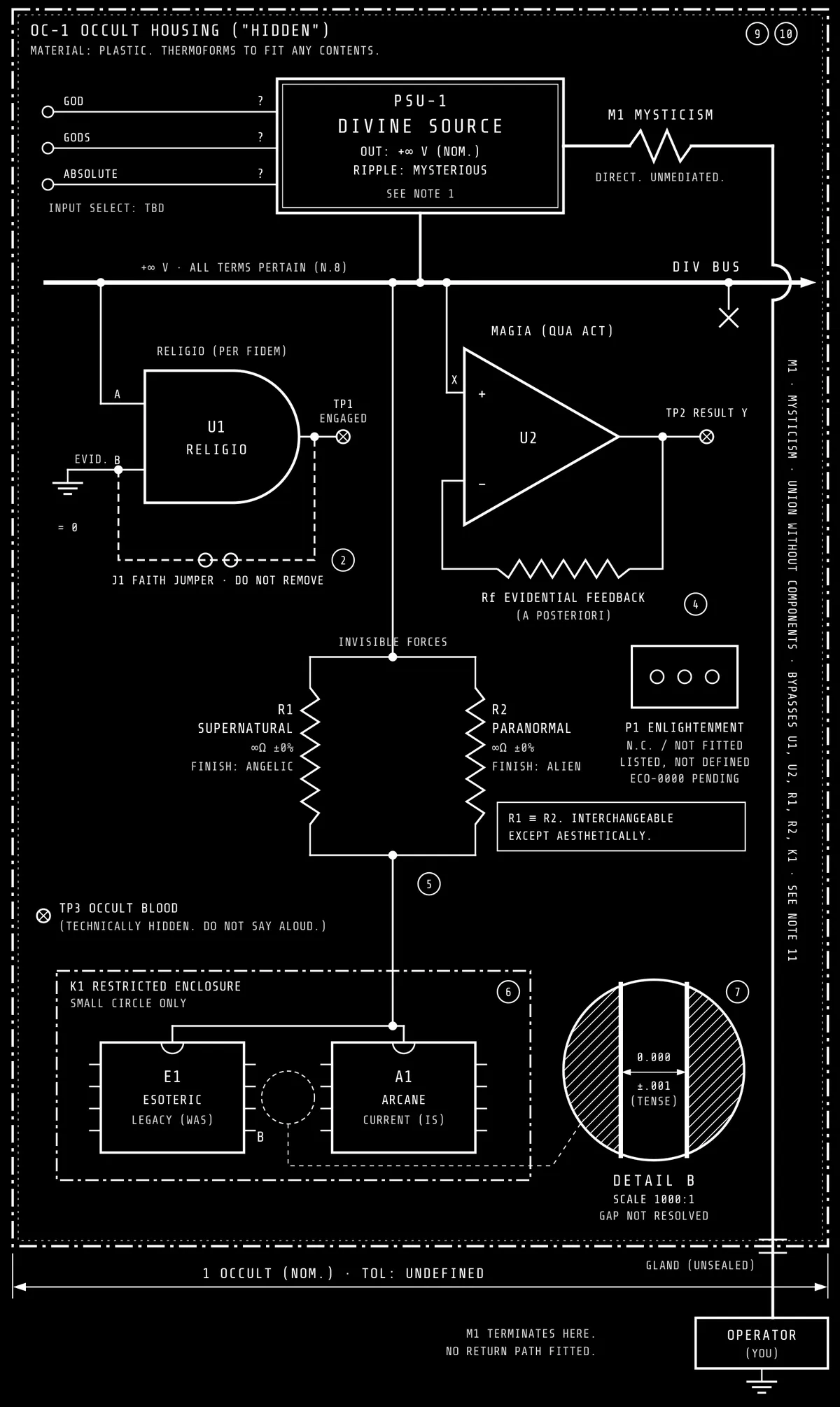
In short, if someone comes to you yapping about what the occult is, or—even worse—what it means, your best tack is to run in the other direction. They’ll try every single trick they can find from all sorts of different directions as a means towards all kinds of different experiences, and the truth is, the only place you find that stuff is [Insert your preferred religion/God/church here].
~
I jest! Let’s be frank here, the point is that the term occult is more a gesture toward a form of epistemic investigation regarding the divine than it is a specific state. Occultism, as far as I’m concerned, is a form of radical skepticism wherein one truly tests the limits of the (apparently) perceivable and sensible world.
It’s not really hidden when lodges are readily contactable and so many grimoires are available for next-day delivery. It’s hardly esoteric when near all inner traditions (barring a few closed ones) have long since been made public. It’s barely mystical when so much of its practical work is concerned with the mundane. More often than not, it’s surprisingly not supernatural or paranormal, but a means toward greater everyday energy flow. And yet, it might also be all of these things in some other, more secretive sense.
Or none of them. It doesn’t matter, not really. You don’t actually want to know what the occult is, because that would put it over there, and then you can only really deal with it on Sundays, which isn’t very productive when it comes to maturation. Nothing is hidden. Nothing ever was. If something was truly hidden, truly unknown, truly occult, so utterly beyond any laws of comprehension that pertain to man, then…I’d assume one wouldn’t even be able to begin to connect with it, let alone write about it.
All that to say: something’s really only hidden if you refuse to look, refuse to see.
~
Be honest. Give up.